
Kahurangi, le bien précieux

Le 9 novembre 1980, la tempête tropicale Jeanne a arraché Kahurangi à son mouillage au large de Seven Mile Beach, à Grand Cayman, et l'a jeté sur un récif de corail. Il y est resté près de trois mois, à la merci de chaque vague qui déferlait sur la barrière. Rares sont les coques en bois qui sortent intactes d'une telle épreuve. Que ce yacht de 1952 navigue encore, et qu'il régate de surcroît sur le circuit des classiques de Méditerranée, s'explique très concrètement. Il faut en chercher la raison dans un chantier d'Auckland, chez un architecte néo-zélandais installé à Londres et dans un bois devenu aujourd'hui presque introuvable.

Un Néo-Zélandais à Londres
Arthur Cecil Robb est né en 1908 à Hawke's Bay, dans l'île du Nord de la Nouvelle-Zélande. Avant de dessiner des bateaux, il est passé par une école d'agriculture et une école d'art, a été apprenti joaillier à Auckland et a travaillé dans un atelier de vitraux. Sur l'eau, il avait la réputation d'être un bon barreur. Au début des années 1930, il est parti en Grande-Bretagne pour se former à la construction navale et, en moins d'un an, il dirigeait déjà le chantier Morris & Lorimer, à Sandbank, sur l'estuaire de la Clyde.
Pendant la Seconde Guerre mondiale, il a servi dans la réserve volontaire de la Royal Navy, où il a atteint le grade de capitaine de corvette. Il a travaillé pour l'Amirauté et pour le ministère de l'Air et, avec Uffa Fox, il a mis au point le canot de sauvetage aéroporté, une embarcation que les avions larguaient en parachute aux équipages abattus en mer. En 1946, il a été fait membre de l'ordre de l'Empire britannique et a ouvert son cabinet d'architecture navale dans le centre de Londres.
De là, il n'a jamais perdu le lien avec son pays. Vers 1950, il a remporté le concours de plans lancé par le Royal New Zealand Yacht Squadron, qui a donné naissance à la classe K, ces croiseurs-régates qui naviguent encore dans le golfe d'Hauraki. À la même époque, il a reçu la commande de Lawrence D. Nathan, arrière-petit-fils de David Nathan, fondateur de L. D. Nathan & Co., considérée comme la plus ancienne entreprise de Nouvelle-Zélande.
Robb est parti de la jauge internationale des 12 m JI, celle de la Coupe de l'America de l'époque, non pas pour dessiner un bateau de jauge, mais un yacht de croisière et de course aux mêmes proportions : long, étroit, aux lignes tendues. Son premier plan mesurait 55 pieds. Doug Bremner, qui devait en être le skipper, l'a vu à Londres et lui a dit qu'il paraissait « tronqué ». Robb a pris la gomme et le crayon et lui a ajouté quatre pieds à l'avant et trois à l'arrière. Résultat : 18,9 mètres de long pour seulement 3,7 mètres de large.
Le chantier de Percy Vos
Percy Vos était revenu de la Première Guerre mondiale simple apprenti. En 1922, lorsque son patron s'est installé à Thames, il a repris l'affaire de Freemans Bay et l'a rebaptisée P. Vos Ltd. En 1937, il s'est établi sur le terrain qui fait aujourd'hui partie du Wynyard Quarter, à côté du port d'Auckland. De sa cale sont sortis des ferries, des bateaux de pêche, des vedettes et les mullet boats typiques du Waitematā. Selon les bons connaisseurs de cette flotte, Kahurangi a été l'un des plus beaux bateaux à glisser sur cette cale.
Il a été construit en kauri, le grand conifère néo-zélandais, un arbre d'une hauteur imposante dont le bois offre des fils très longs et sans nœuds. La coque a suivi la méthode traditionnelle locale : varangues, lisses et un bordé en trois couches. Les deux couches intérieures font chacune 3/8 de pouce ; la couche extérieure, 7/8. Au total, un peu plus de trois centimètres de kauri croisé, fixé par des rivets en cuivre et des vis en bronze au silicium. Cette structure, qui répartit les efforts dans plusieurs directions, est ce qui lui permettrait, des années plus tard, de résister au récif de Grand Cayman.
Le chantier a duré deux ans. Kahurangi a été mis à l'eau le 20 novembre 1952. Son nom signifie « bien précieux » en maori.
Percy Vos est mort en 1972 et, avec lui, la construction commerciale en bois s'est pratiquement éteinte en Nouvelle-Zélande. Le chantier a fermé en 1994. Après une longue restauration, il est aujourd'hui géré par le Musée maritime de Nouvelle-Zélande et c'est le seul chantier traditionnel de ce type qui subsiste à Auckland. En mars de cette année, il a rouvert ses portes au public, avec l'École de construction navale traditionnelle et des ateliers de charpenterie de marine.
The Big K
Pendant des années, Kahurangi a été le navire amiral du Royal New Zealand Yacht Squadron et, sous son guidon, il a remporté presque tous les trophées de première division. Beaucoup de ces trophées portent encore son nom. Le club conserve une demi-coque du bateau, et une sculpture en bronze en rappelle le souvenir à l'entrée.
Nathan l'a toujours tenu impeccable, et une bonne partie de la voile néo-zélandaise de l'époque est passée par son pont : Scott Colville, Willie Nelson, Wally Stuhlmann, mais aussi Penny Whiting, qui a fait partie de l'équipage pendant plusieurs saisons. Entre 1963 et 1966, Nathan en a partagé la propriété avec Bremner et Colville.
C'était, en outre, un bateau très photographié. Sa silhouette figurait sur des calendriers et des couvercles de boîtes à biscuits. À Auckland, on l'appelait « The Big K », car peu de yachts de cette taille avaient été construits dans le pays.
Le grand large
En 1967, Kahurangi a couru sa première course océanique, d'Auckland à la Nouvelle-Calédonie, quelque 1 300 milles. En décembre de la même année, il a pris le départ de la Sydney-Hobart. À bord se trouvait un Peter Blake de 19 ans, celui-là même qui, des décennies plus tard, remporterait la Whitbread sur Steinlager 2 et deux Coupes de l'America pour la Nouvelle-Zélande.
À la cuisine officiait un Français de 24 ans, Alain Colas, qui enseignait le français à l'université de Sydney et avait découvert la voile dans la baie à peine un an plus tôt. C'était sa première course au large. Pendant la navigation, il n'avait d'yeux que pour un autre bateau : Pen Duick III, la goélette en aluminium d'Éric Tabarly, qui avait tout gagné en Europe cette saison-là.
Tabarly est arrivé premier à Hobart en temps réel, mais la victoire en temps compensé est revenue au néo-zélandais Rainbow II. Kahurangi a terminé troisième. Sur les quais de Hobart, Colas a fait la connaissance de Tabarly. Comme une bonne partie de son équipage était déjà rentrée en France, Tabarly l'a invité à naviguer avec lui jusqu'en Nouvelle-Calédonie. Colas a demandé une année sans solde, a appris la navigation à ses côtés, puis lui a racheté le trimaran Pen Duick IV. Il l'a rebaptisé Manureva et a bouclé à son bord le premier tour du monde en solitaire en multicoque. Il a disparu avec ce bateau en 1978, lors de la première Route du Rhum.
Un tour du monde inachevé
En 1977, Kahurangi a quitté Auckland pour faire le tour du monde. Il n'est jamais revenu. Trois ans plus tard sont arrivés la tempête Jeanne, le récif et les trois mois d'échouage. Ont suivi des décennies loin du Pacifique, jusqu'à ce que le bateau passe entre les mains de John C. Olsen.
En 2006, Olsen l'a vendu à Pepe de Miguel, biologiste marin, photographe et cinéaste. La vente s'est accompagnée de deux promesses : ramener Kahurangi en Nouvelle-Zélande, et prévenir Olsen depuis la dernière escale pour qu'il puisse naviguer avec l'équipage la dernière étape jusqu'à Auckland. Olsen est mort avant, et la seconde promesse ne pourra plus être tenue. La première tient toujours.
Le projet consiste à ramener le bateau à Auckland par ses propres moyens, par étapes, avec des équipiers liés à son histoire et de jeunes régatiers. Un documentaire serait tourné pendant la traversée et un livre de photographies serait publié. Une fois rentré, le bateau serait offert à la Nouvelle-Zélande par l'intermédiaire d'une fondation.
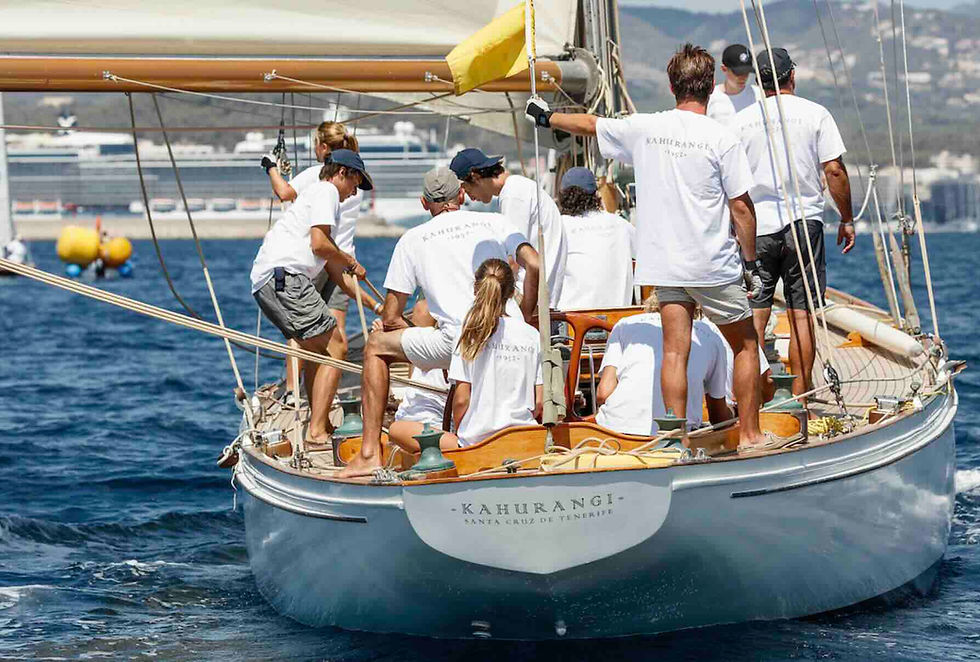
En attendant, Kahurangi régate dans les eaux espagnoles et dans le reste de la Méditerranée. En 2016, il a terminé deuxième de la classe Classiques à l'Illes Balears Clàssics de Palma, et c'est un habitué de la Copa del Rey de Barcos de Época de Mahón.
À Auckland, le hangar de Percy Vos sent de nouveau le bois fraîchement raboté. Si le voyage de retour se concrétise, Kahurangi entrera dans le Waitematā un demi-siècle après l'avoir quitté, à quelques centaines de mètres de la cale d'où il a été mis à l'eau.
Kahurangi, the treasured possession
On 9 November 1980, Tropical Storm Jeanne tore Kahurangi from her mooring off Seven Mile Beach, Grand Cayman, and threw her onto a coral reef. She lay there for almost three months, at the mercy of every wave that broke over the barrier. Few wooden hulls come out of something like that in one piece. That this 1952 yacht is still sailing — and racing on the Mediterranean classic circuit, no less — has a concrete explanation. It lies in an Auckland boatyard, in a New Zealand designer based in London, and in a timber that is now almost impossible to obtain.
A New Zealander in London
Arthur Cecil Robb was born in 1908 in Hawke's Bay, on New Zealand's North Island. Before he drew boats, he went through an agricultural college and an art school, served as an apprentice jeweller in Auckland and worked in a stained-glass studio. On the water he was known as a fine helmsman. In the early 1930s he travelled to Britain to train in boatbuilding, and within a year he was running the Morris & Lorimer yard at Sandbank, on the Firth of Clyde.
During the Second World War he served in the Royal Naval Volunteer Reserve, rising to lieutenant commander. He worked for the Admiralty and the Air Ministry and, together with Uffa Fox, developed the airborne lifeboat, a craft dropped by parachute from aircraft to crews downed at sea. In 1946 he was appointed to the Order of the British Empire and opened his design office in central London.
From there he never lost touch with home. Around 1950 he won the design competition held by the Royal New Zealand Yacht Squadron that gave rise to the K Class, the cruiser-racers that still sail on the Hauraki Gulf. In those same years he received a commission from Lawrence D. Nathan, great-grandson of David Nathan, founder of L. D. Nathan & Co., regarded as New Zealand's oldest company.
Robb took as his starting point the International 12 Metre rule, the America's Cup rule of the day — not to design a rule boat, but a cruiser-racer with those proportions: long, narrow and taut-lined. His first plan measured 55 feet. Doug Bremner, who was to skipper the boat, saw it in London and told him it looked "chopped off". Robb reached for his eraser and pencil and added four feet at the bow and three at the stern. The result was 18.9 metres overall with a beam of just 3.7 metres.
Percy Vos's yard
Percy Vos had come back from the First World War as a mere apprentice. In 1922, when his employer moved to Thames, he took over the Freemans Bay business and renamed it P. Vos Ltd. In 1937 he moved to the site that is now part of Wynyard Quarter, beside Auckland's harbour. Ferries, fishing boats, launches and the mullet boats typical of the Waitematā came off his slipway. Kahurangi, according to those who know that fleet well, was one of the most beautiful boats ever to slide down it.
She was built of kauri, New Zealand's giant native conifer, a towering tree whose timber offers very long, knot-free grain. The hull followed the traditional local method: floors, stringers and three-skin planking. The two inner skins are 3/8 inch each; the outer one, 7/8. In all, just over three centimetres of cross-laid kauri, fastened with copper rivets and silicon bronze screws. That structure, which spreads loads in several directions, is what would later allow her to withstand the Grand Cayman reef.
Construction took two years. Kahurangi was launched on 20 November 1952. Her name means "treasured possession" in Māori.
Percy Vos died in 1972 and, with him, commercial wooden boatbuilding in New Zealand effectively came to an end. The yard closed in 1994. After a long restoration it is now run by the New Zealand Maritime Museum and is the only traditional yard of its kind surviving in Auckland. In March this year it reopened to the public, with the Traditional Boatbuilding School and wooden boatbuilding workshops.
The Big K
For years Kahurangi was the flagship of the Royal New Zealand Yacht Squadron and, under its burgee, she won almost every first-division trophy. Many of those trophies still bear her name. The club keeps a half-model of the boat, and a bronze sculpture commemorates her at the entrance.
Nathan always kept her immaculate, and a good part of New Zealand sailing of the era passed across her deck: Scott Colville, Willie Nelson, Wally Stuhlmann and also Penny Whiting, who was part of the crew for several seasons. Between 1963 and 1966 Nathan shared ownership with Bremner and Colville.
She was also a much-photographed boat. Her silhouette appeared on calendars and on the lids of biscuit tins. In Auckland she was known as "The Big K", because few yachts of her size had been built in the country.
Open water
In 1967 Kahurangi sailed her first ocean race, from Auckland to New Caledonia, some 1,300 miles. In December of that year she was on the start line of the Sydney Hobart. On board was a 19-year-old Peter Blake, the same man who decades later would win the Whitbread with Steinlager 2 and two America's Cups for New Zealand.
In the galley was a 24-year-old Frenchman, Alain Colas, who taught French at the University of Sydney and had discovered sailing on the harbour barely a year before. It was his first offshore race. As he sailed, his eyes were on another boat: Pen Duick III, Éric Tabarly's aluminium schooner, which had won everything in Europe that season.
Tabarly was first into Hobart on line honours, although the handicap win went to the New Zealand yacht Rainbow II. Kahurangi finished third. On the Hobart docks, Colas met Tabarly. With much of his crew already back in France, Tabarly invited him to sail with him to New Caledonia. Colas took a year's unpaid leave, learned navigation at his side and later bought the trimaran Pen Duick IV from him. He renamed her Manureva and in her completed the first single-handed circumnavigation in a multihull. He disappeared with her in 1978, during the first Route du Rhum.
A circumnavigation left unfinished
In 1977 Kahurangi left Auckland to sail around the world. She never came back. Three years later came Storm Jeanne, the reef and the three months aground. What followed were decades far from the Pacific, until the boat passed into the hands of John C. Olsen.
In 2006 Olsen sold her to Pepe de Miguel, a marine biologist, photographer and film-maker. The sale came with two promises: to take Kahurangi back to New Zealand, and to let Olsen know from the last port of call so that he could sail the final leg to Auckland with the crew. Olsen died first, and the second promise can no longer be kept. The first still stands.
The plan is to bring the boat back to Auckland under her own sail, in stages, with crew connected to her history and young sailors. A documentary would be filmed during the voyage and a photography book published. Once home, the boat would be donated to New Zealand through a foundation.
In the meantime, Kahurangi races in Spanish waters and across the rest of the Mediterranean. In 2016 she finished second in the Classics class at the Illes Balears Clàssics in Palma, and she is a regular at the Copa del Rey de Barcos de Época in Mahón.
In Auckland, Percy Vos's shed smells of freshly planed timber once again. If the voyage home comes about, Kahurangi will sail into the Waitematā half a century after leaving it, a few hundred metres from the slipway where she was launched.


Commentaires